The first blog in this series covered how AI treats a brand less like a single webpage and more like a web of everything the internet knows about it: the website, the reviews, the social presence, the citations, all of it working together or working against each other. That idea explains why visibility has changed, but it doesn't explain what to do about it.
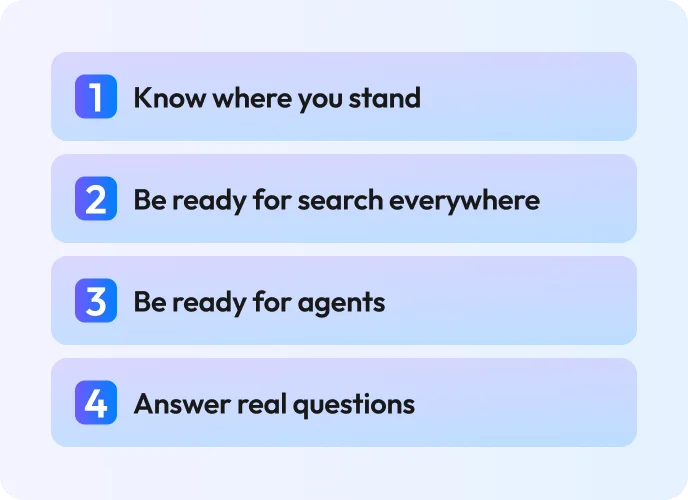
William Haddad, SVP of Product for Search Optimization, has been working on that question, and he's landed on a simple framework. Getting cited and measuring AI search performance is complicated, but four specific things help drive a framework for how to think about success in this new emerging channel.
The gap is already showing up in the questions coming in
Before getting into the framework, it's worth noting where the need for one came from. Terms like AEO and GEO get thrown around constantly, but there's no shared, simple definition of what they actually mean or what doing them well looks like, even among people who work in search marketing every day.
Haddad's take: "Most people talking about AEO and GEO right now don't have a shared definition of what the optimization effort actually means or what winning looks like. Most agencies sell ranking, strategies, and keywords, and there is a lot of content about AIO for large consumer brands or software companies, but nobody's given the market a clear, simple answer for what this new discipline actually requires for the local search market."
That's what the framework is for. Not more jargon, but a standard simple enough for an account manager, a client, and a business owner to all use the same way.
1. Know where you stand
"You have to know where you stand," Haddad says. "Are you visible or being cited? What are you visible for? Are you recommended? What does AI actually say about your brand? Is it accurate, favorable and consistent?"
Until recently, most businesses had no real way to answer those questions. AI search behaves differently for every query, every model, and every region, so there was no clean report to point to. That gap is closing, and it's revealing something uncomfortable: a business can rank on page one of Google and still not be the recommended business in an AI-generated answer. Having a strong ranking position used to correlate with conversions, but now you must rank well, hopefully be cited by AI when it counts, and most importantly, consider what AI says about you when you are visible. In some ways, that’s even more important than ranking well today.
2. Be ready for search everywhere
This is the direct extension of the spider web idea from the first blog in our series. AI doesn't pull from one source when it builds an answer about a business. It pulls from listings, citations, social posts, video, reviews, and whatever else it can find. A business that's technically sound on its website but inconsistent or absent everywhere else is still going to come up short, because AI is checking the whole web, not just the channels and content a business controls directly. Being ready for search everywhere means treating those channels as one connected ecosystem instead of a set of separate boxes to check. Reputation management and consistency on multiple surfaces is the new NAP consistency of the AI search optimization standards.
3. Be ready for agents
"Your site needs to be technically sound," Haddad explains, pointing to properly structured content, schema and web vitals as the concrete building blocks.
AI agents don't browse a site the way a person does. They need structure and organization, to quickly understand what a website is actually about, what content to consume, and whether it's a trustworthy source that will ultimately answer the user's question. A site can look great to a human visitor and still be difficult or inefficient for an AI agent to parse correctly. Beyond the website, agentic experiences will continue to emerge and integrate in the customer search experience. A fully integrated scheduling and reputation system is the foundation for AI to make verified recommendations to consumers. Getting that technical layer right is table stakes for being an option that AI will cite or recommend at all.
4. Answer real questions
Once a business has built authority and consistency across the web, the real work starts. Proof that a business exists and is trustworthy isn't enough. AI search needs content that answers what a potential customer is asking, not content built around a keyword list.
That means:
FAQs that address the specific questions customers ask, not generic category pages
Full, accurate service area coverage that stays consistent across the site
An internal linking strategy that points AI (and users) toward the pages that answer the questions people come to the site for
Giving AI enough information, data, and detail about the business to parse, organize, and use when it builds an answer
A page about medical malpractice in general terms doesn't help a law firm get cited for medical malpractice cases. A page built around the real questions a potential client would ask about that specific practice area does.
This is also the piece most businesses already have some foundation for, since it overlaps with traditional content strategy. The shift is in how directly that content needs to map to real, specific questions instead of broad topics.
None of this replaces the work. It adds to it.
These four things don't sit on top of SEO fundamentals as an alternative approach. They sit on top of the same foundation this series has been building on all along: content, consistency, and a brand that shows up the same way no matter where someone finds it. What's changed is the number of places that consistency now needs to reach, and how directly it needs to answer the questions people are asking AI.
If you're already with Scorpion, ask your account manager how your brand is doing against these four right now. If you're not, let's talk.