For years, the industry has measured marketing performance by the wrong things, like clicks, impressions, and lead volume. They show up cleanly in dashboards and they sound productive in reports, but none of them answer the question that matters most to a business owner watching the bank account: which of those marketing dollars turned into revenue?
Most marketing platforms track what happens before a prospect contacts you, such as the clicks, the searches, and the ads they saw. But what happens after, whether they booked the job, signed the case, or paid the invoice, lives in your Customer Relationship Management system (CRM). And with that gap, marketing dollars get misallocated every day.
Where The Money Goes Missing
The disconnect is widespread, and the data backs it up. According to Scorpion's 2026 State of Home Services Marketing Report, 67% of home services business leaders say they can't connect their marketing spend to revenue.
For many, your marketing platform stops at the lead, and your CRM shows booked work, completed jobs, and collected revenue, but they’re hiding their data from each other, making it nearly impossible to tell how your marketing investments are impacting your revenue. When those two systems don't share data, the budget flows towards whatever looks good on a click report, even when it isn’t converting. The channels bringing in revenue get cut, because nobody can tie them back to revenue, and the spend drifts to the wrong places.
When Your Marketing and Your CRM Finally Talk
Once your marketing platform and CRM share data, you can trace a single click or phone call all the way to the signed case and the revenue it brought in. That’s Revenue Intelligence, and it replaces manual ROI tracking with a secure, always-on feedback loop between the two systems. It closes the gap between marketing activity and revenue outcomes, so the picture you get is faster, clearer, and grounded in what moved the needle.
From Spreadsheets and Gut Calls to Real Answers
The old way meant tracking ROI by pulling monthly client lists into spreadsheets, exchanging revenue data through email and inconsistent handoffs, and making marketing decisions based on information that was weeks or months old by the time anyone could act on it. The work was manual, the data was unreliable, and the cycle was slow enough that the market often moved before the insight did.
The new way automates the handoff entirely. With Scorpion’s integrations, CRM data flows into Scorpion’s marketing platform in real time, without manual exports or unsecure channels. Marketing decisions get made against verified outcomes rather than surface-level metrics. The difference between the two approaches is the difference between guessing where the revenue came from and knowing.
And it pays off. Since 2024, the Scorpion and Clio integration has generated more than $210 million for the law firms using it.
Six Views that Change How You Make Decisions
Once Scorpion is integrated with your CRM, the data feedback loop is in place and six views open up that help your business get more successful outcomes.
The Dashboard gives you a snapshot of revenue and ROI at a glance, with total revenue, marketing investment, and year-over-year comparisons in one place. It answers the question every business owner asks first: how are we doing? Performance goes deeper, comparing revenue directly to marketing investment so you can see how efficiently each dollar is converting at the campaign level. Conversions map the full path from first contact to paying customer or client, showing where prospects move forward, where they drop off, and where the funnel needs work.
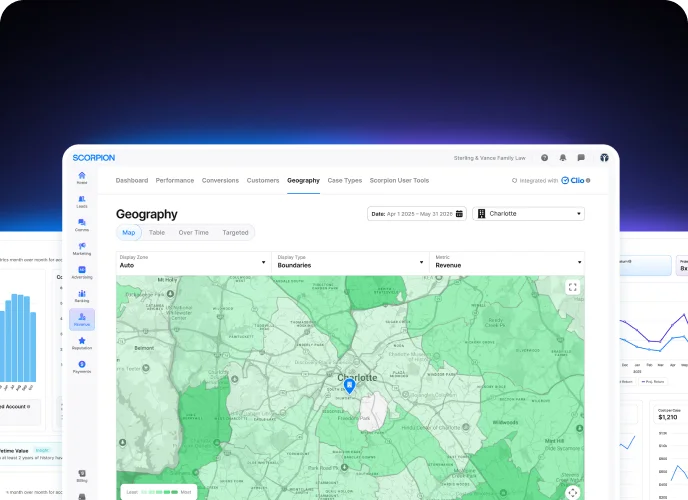
Customers bring attribution down to the individual level, showing which buyers came in, when, through which channel, and what they were worth to the business. Geography delivers a heatmap of revenue down to the neighborhood and zip code, making the most profitable locations clearly visible alongside the ones underperforming. That view is what makes precision possible for campaigns built around geographic targeting, because the data tells you where to invest more and where to pull back. Service categories break revenue out by the kind of work driving it. Whether that's job types in home services or practice areas in legal, you see exactly which lines of business are producing the highest-value revenue.
When Your Marketing Knows Your Operations, Everything Gets Clearer
Revenue Intelligence is built to work with the CRMs local businesses already rely on to run their day-to-day operations. In home services, that includes platforms like ServiceTitan, Housecall Pro, FieldRoutes, Aspire, and AccuLynx and more. In legal, that includes Clio, Filevine, LeadDocket, and Lawmatics and more. The integrations connect marketing performance directly to the operational data that defines success for each kind of business. With Knee's Electrical Services, this was made possible through Scorpion's direct integration with ServiceTitan. They traced job outcomes and revenue back to specific campaigns, earning a 12x return on their total marketing investment.
“RevenueMAX helped me get the best possible ROI on my marketing. Before working with Scorpion, we were under $1 million in revenue. We’re now close to hitting $5 million. Scorpion gives me visibility into exactly which campaigns and channels drive new jobs.” - Levi Biggs, Owner, Knee’s Electrical Service
Transparency Into What Your Investments are Delivering
Marketing that doesn't know what your CRM knows is flying half-blind and probably won’t get you to where you’re trying to head. Clicks, impressions, and lead volume describe activity, not outcomes, and activity doesn’t pay the bills.
Revenue Intelligence closes that gap, and it sits at the core of RevenueMAX, Scorpion's full collection of digital marketing solutions for local businesses. Every campaign gets a direct line back to the revenue it produced, so you know exactly what's worth spending on.
"Scorpion's integration with Clio is the final puzzle piece and it's solving the biggest issue facing law firms, getting new clients. Now firms can tie their marketing spend to revenue and understand what's working, giving them a clear path to growth." - Jordan Couch, Palace Law
If you want to see exactly which marketing dollars are turning into revenue, let’s talk.



.png)