.png.webp)
Most law firms evaluate their marketing the same way: How many leads did we get? What did we spend? What's the cost per lead? Those are fine questions, but those are only indicators of efficiency. They don't tell you where your firm should go next.
The firms we work with that are growing the fastest have moved past indicators alone. They're not just asking "is our marketing working?" They're asking, "What is our marketing data telling us about our business?" And the answers are changing how they make decisions about hiring, practice area investment, budget allocation, and expansion.
That shift doesn't require a new strategy. It requires better visibility into (and usage of) the data you're already generating.
The Difference Between Improving Campaigns and Making Business Decisions
There's an important distinction between using marketing data to improve campaigns and using it to inform business decisions. Most firms, and most agencies, stop at campaign performance. Which keywords are converting? Which ad groups should we pause? Where should we shift budget this month? That’s still important work.
But when your marketing data is connected to your case management system, it can answer a completely different set of questions:
Which practice area is producing the strongest revenue signal relative to what you're spending on it?
Are you staffed to handle the volume in the areas where your marketing is working best?
Is there a case type where demand is growing faster than your capacity to take on new clients?
Are you investing marketing dollars in areas where case values are declining or underinvesting where they're rising?
Is there a market where new client demand is building but your firm has no presence?
Those aren't marketing questions. Those are business questions. And the answers are sitting inside the data that most firms never look at beyond a monthly performance report.
What This Looks Like in (Your) Practice
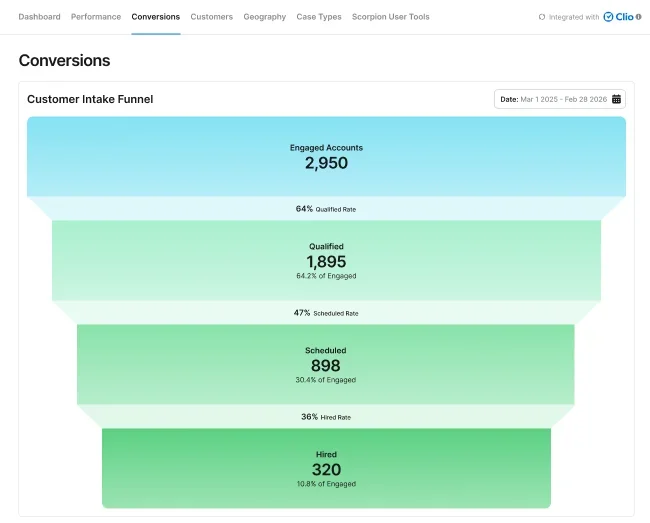
One of the things our integration with Clio makes possible is connecting marketing performance data to actual case outcomes: by geography, by practice area, by campaign. When those two systems are talking to each other, patterns start to emerge.
Practice area investment. A family law firm might be running campaigns across divorce, custody, and adoption. The lead volume looks similar across all three. But when marketing data connects to case management, a different picture emerges: custody cases are converting to signed retainers at nearly twice the rate of the others, at a higher average case value. That's not something you'd see in a lead report. It only surfaces when marketing and case data are in the same view. Now the question isn’t"should we spend more on ads?" It’s"should we shift investment toward custody and scale back on the areas producing lower returns?"
Staffing ahead of demand. A criminal defense firm sees steady lead flow across DUI, drug offenses, and domestic violence. But connected data shows DUI consultations converting to retained clients at an accelerating rate over the last two quarters, and the attorneys handling those cases are already at capacity. That's not a signal to spend more on DUI marketing. It's a signal that the firm is about to start losing cases it already paid to acquire. The firms that act on that signal hire ahead of demand. The ones that wait end up paying for leads they can’t convert.
Budget reallocation. A personal injury firm is spreading its marketing budget evenly across auto accidents, slip-and-fall, and workers' comp. Connected data reveals auto accident cases are converting at a stronger rate with higher case values than workers' comp. Meanwhile, workers' comp lead volume has been declining for six months. The firm doesn't need a new marketing strategy. It needs to stop treating every practice area as equally worth investing in. Shifting budget toward auto accidents doesn't just improve cost per lead. It changes the revenue mix of the entire firm. And pulling back on a declining practice area frees up dollars that were producing less every month.
Each of these insights changes the trajectory of a firm, not just the performance of a campaign.
Why Managing Partners Should Care About Marketing Data
If you're a managing partner or firm owner, marketing reports probably aren't the first thing you look at in the morning. And that makes sense. You're focused on case outcomes, staffing, profitability, and long-term growth. Marketing often gets delegated to someone else or reviewed as a line item on a monthly P&L.
But the data inside your marketing platform, especially when it's connected to your operations, is some of the most valuable business intelligence your firm has access to. It tells you which practice areas are gaining momentum before you feel it in your caseload, and gives you a forward-looking signal on revenue, not just a backward-looking report on what already happened.
The firms that treat marketing data as business intelligence aren’t guessing about where to grow. They're letting the data show them.
The Connection Makes It Possible
None of this works if your marketing lives in one system and your case management lives in another. When those two worlds are disconnected, you get lead counts on one side and revenue reports on the other, with no way to draw a line between them.
That's why we invested in a deep technology partnership with Clio, building a custom API that connects marketing performance directly to case outcomes. When leads generated by Scorpion flow into a firm's case management system, and case outcomes flow back to us, the full picture becomes visible. You're not looking at marketing metrics and business metrics separately. You're seeing them as one connected story.
We've written before about how that data connection works and how it helps firms see ROI faster. What we want to emphasize here is what becomes possible once that connection is in place. The integration isn't just about better reporting. It's about giving your firm the information it needs to make growth decisions with confidence.
Stop Reporting. Start Deciding.
The most valuable thing your marketing can give you isn't a lead. It's clarity about where your best opportunities are, where your firm is underinvested, and where the market is moving before your competitors see it.
If your marketing data is only telling you how your campaigns performed last month, you're leaving the most valuable insights on the table.
We'd like to show you what that looks like for your firm.
.jpg.webp)