AI is everywhere in legal marketing, but most of it is noise. The only questions that really matter are: where does AI actually help a firm sign more cases and grow revenue and where does it add risk without results?
This article draws directly from our Not All AI Is Created Equal guide and outlines what to demand from any marketing AI solution, plus the questions that reveal whether a vendor is actually built for law firms.
The Problem: AI Noise Is Everywhere
Law firm leaders are being marketed to aggressively around AI. Nearly every tool promises better marketing, easier intake, or faster growth. Yet very few explain how those promises translate into retained clients.
The core question firms should be asking is not “Does this tool use AI?” It’s: Where does AI actually increase retained cases and revenue?
Firms that are pulling ahead tend to share a few common traits:
- They are visible to the right potential clients at the right moment.
- They respond within minutes, not hours or days.
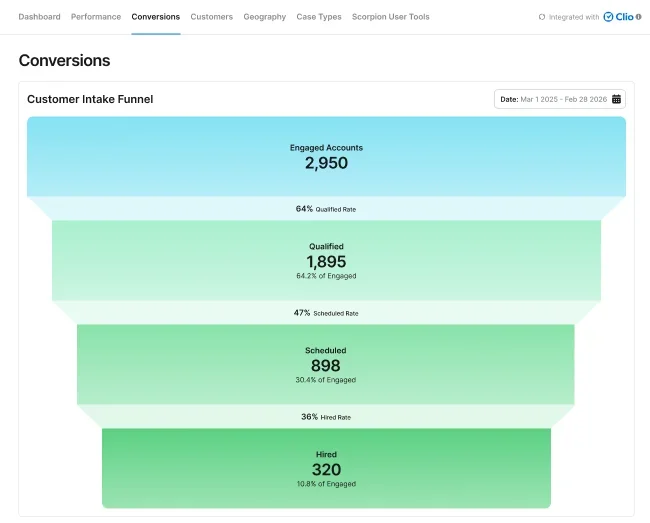
- They move accurate information cleanly into intake and case management so staff can act quickly.
The risk comes from adopting disconnected tools that create more work instead of less. AI that lives in silos often leads to duplicate data entry, inconsistent information, and gaps between marketing, intake, and follow-up. When that happens, response times slow, opportunities are missed, and growth stalls, even if lead volume looks healthy.
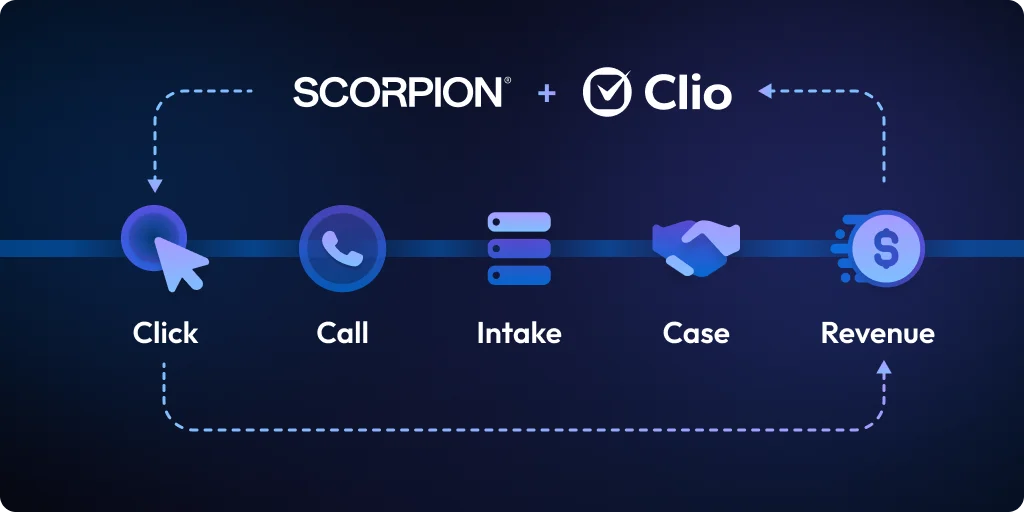
When used correctly in your marketing strategy, AI should reduce friction across the entire journey from first click to signed case. If it doesn’t, it’s just another layer of complexity.
AI Adoption Is Not Increasing. It Is Skyrocketing.
AI adoption in the legal industry has moved past experimentation.
In 2023, only 19% of firms reported using AI. Today, 79% of legal professionals use AI in some capacity.
More important than adoption alone is performance. Among firms classified as “wide adopters” of AI, 69% report a positive revenue impact, compared to 36% across all firms. That gap highlights an important truth: results depend on how AI is applied, not simply whether it exists.
For law firm owners, this shifts the planning conversation. AI should be assumed as part of the strategy. The focus should move to:
- Search visibility that brings in qualified clients
- Faster first response across calls, chat, and forms
- Consistent follow-up that prevents dropped opportunities
- Clean handoffs into intake and case management
Firms that partner with the right marketing partner who uses AI responsibly, are able to connect their investment directly to signed cases. That means setting expectations around metrics that matter, such as response time, consultations scheduled, and signed cases, rather than surface-level activity like clicks or impressions.
What Law Firms Should Demand From AI
When evaluating any AI-driven marketing solution, firms should hold it to four standards.
- Real value: AI should impact signed cases and revenue, not just traffic, calls, or lead volume. If performance cannot be tied to consultations and retained cases, the value is unclear.
- Built for legal: Legal consumers behave differently than retail or e-commerce buyers. AI must reflect how people choose attorneys, how urgency varies by practice area, and how intake actually works inside a firm.
- Integrated systems: AI should connect advertising, websites, chat, calls, forms, and other communications, and continue into intake and case management. Disconnected tools create gaps, while integrated systems create continuity.
- Proven results: Claims should be supported by outcomes from comparable firms. That includes starting metrics, measured improvement, and clarity around what drove the change.
Scorpion’s approach to AI is built around these principles inside Scorpion's RevenueMAX, where marketing, intake, and case management performance are connected.
AI insights are tied directly to signed-case revenue, giving firms visibility into what is working and where to invest next.
Questions to Ask Any Vendor Using AI for Marketing
Before committing to any AI-driven marketing solution, law firm leaders should slow the conversation down and ask direct questions. The answers reveal whether a vendor understands legal risk, operational reality, and business outcomes, or whether AI is simply a selling point.
When reviewing a vendor, ask:
How is client data protected across prompts, storage, access, and retention?
Law firms handle sensitive information. AI systems must use secure, private environments with clear rules around data use and retention.
What legal-specific training guides responses and intake?
Generic AI does not understand legal urgency, jurisdictional nuance, or intake boundaries. Vendors should be able to explain how their systems are tuned for legal use.
How does the system integrate with our intake and case management?
AI should reduce manual work, not create it. Data should move cleanly from first contact into the systems your team already uses.
How does performance connect to signed-case revenue, not just leads?
Leads alone do not pay the bills. Vendors should show how AI performance ties to consultations, retained cases, and revenue.
How does it save staff time and reduce manual work?
If AI creates more steps for your team, efficiency gains disappear.
What results have you delivered to firms in markets like ours?
Proof matters. Look for outcomes from firms with similar practice areas, competition levels, and growth goals.
The strongest partners answer these questions directly, with documentation and examples, not vague assurances.
Moving Forward With Confidence
Not all AI delivers the same results. Firms that find the right partner and approach AI with clear expectations, measurable goals, and an integrated strategy are better positioned to turn adoption into growth.
RevenueMAX was built to connect AI-driven marketing, intake, and case management into a single system focused on outcomes. That connection is what allows firms to improve visibility, respond faster, and convert more opportunities without adding strain to their teams.
For law firm leaders, the next step is not chasing the latest AI trend. It’s choosing solutions that support how the firm actually operates and that make growth easier to measure, manage, and sustain.
If you want to understand how Scorpion applies AI to deliver measurable results, a conversation with our team can help clarify what’s possible for your firm.
.png.webp)
.jpg.webp)