.jpg.webp)
Key Takeaways
- 79% of legal professionals now use AI, but most firms cannot connect their marketing spend to signed cases.
- The biggest gap in legal AI is disconnected systems, such as ad platforms, intake tools, and case management, that do not share data.
- Nearly two-thirds of clients feel uncomfortable when lawyers use AI to respond to them directly, making legal-specific AI a necessity rather than a preference.
- Only half of firms using AI have an AI policy in place, creating real confidentiality risk.
- High-performing firms using integrated systems are signing cases faster without increasing their marketing budgets.
---
The Four Questions Every Law Firm Should Ask Before Buying an AI Marketing Tool
It seems like every vendor selling to law firms has an AI story. Emails, webinars and booth conversations all prove that AI is the loudest word in legal marketing right now. But loud does not mean useful, and a lot of firms are discovering that the hard way after signing contracts for tools that promised efficiency and delivered extra spreadsheets.
Scorpion and Clio’s webinar titled Four Standards Every Law Firm Should Use to Evaluate AI, was built to give firms a practical framework to evaluate any AI marketing tool.
Most Firms Cannot Tell You Which AI Tool Actually Signed a Case
79% of legal professionals now use AI in some capacity, roughly 4 out of 5 attorneys. Among firms using it widely, 69% report a positive revenue impact. But "positive revenue impact" covers a lot of ground, and most firms cannot actually trace it back to signed cases.
Buying a tool that adds tasks, creates disconnected data, and cannot answer the most important question at the end of the month (what marketing produced signed clients) is worse than buying nothing at all.
The Four Standards to Hold Any AI Marketing Tool To
Before cutting a check on any AI tool or marketing vendor, every firm should walk away with clear answers to these four questions.
1. Does it impact signed cases, not just clicks?
Clicks, traffic, and leads are all noise if they do not connect to revenue. The only number that matters at the end of the month is how many cases your firm signed. Ask for that number specifically. If a vendor's pitch is built around impressions and click-through rates, your firm is evaluating the wrong metric with them.
2. Does it connect your marketing, intake, and case management, or does it create another data island?
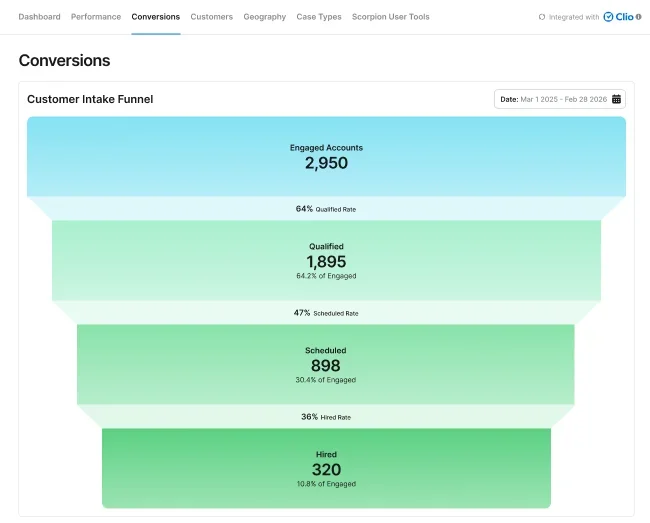
Most firms are running four or five disconnected tools where none of them talk to each other, so staff end up manually transferring data between systems, leads fall through the cracks, and at the end of the month, nobody can tell which marketing actually produced signed cases.
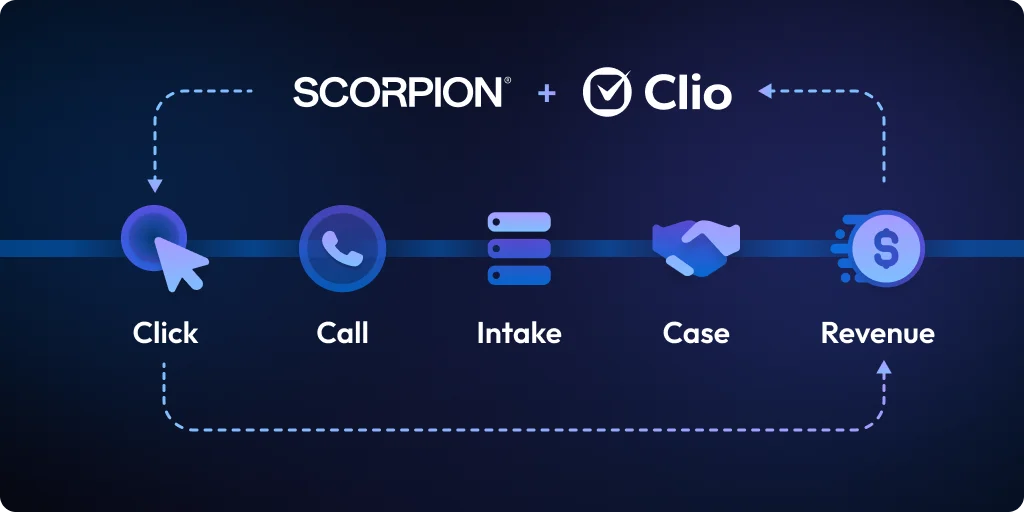
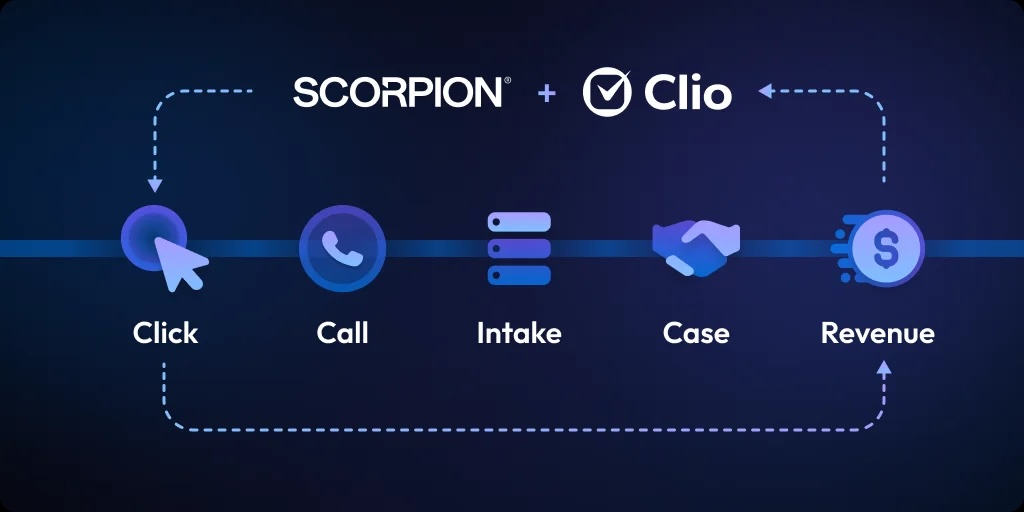
When systems are truly integrated, a lead that comes in at midnight can have a clean record, contact information, urgency level, and a consultation already scheduled before anyone on your team starts the day. Scorpion is Clio's sole preferred digital marketing partner and the only marketing agency using data from both Clio Manage and Clio Grow to make smarter marketing decisions for law firms, connecting every step from first click to signed case.
3. Is it built for how legal consumers actually make decisions?
A generic customer service chatbot was not trained for someone in the middle of a custody dispute or facing criminal charges. Legal-specific AI understands urgency levels, handles sensitive information appropriately, and works from your firm's approved content rather than generating responses on its own. A practical test is to ask any vendor to show exactly how their AI handles an after-hours inquiry from someone in emotional distress. If they cannot demonstrate it in a live scenario, that is worth paying attention to.
4. Can the vendor show verified results from firms like yours?
Ask for actual performance numbers with context on who it worked for. That means a firm your size, in a market similar to yours, with before and after data and a clear explanation of what changed. If a vendor cannot tell your firm what the starting point was, what specifically drove the improvement, and over what time period, the results are not real enough to bet on.
What to Do Before Talking to Any Vendor
Clio's research surfaced a gap worth addressing directly. Of the 79% of firms using AI, only half have an AI policy in place. That means a staff member under deadline pressure who puts sensitive client information into an unvetted AI system can compromise confidentiality in ways that are hard to walk back.
Before evaluating tools, every firm should define what "success" looks like in measurable terms. More signed cases, lower cost per lead, faster intake turnaround.
Establish what data any vendor can and cannot access, and get answers in writing on data storage, subprocessors, and breach protocols. A vendor that cannot answer those questions in writing is not ready to be inside your client data.
A Four Step Intake Flow to Start Using Now
Independent of any AI tool, these are the four things high-performing firms are doing to make sure no lead slips through the cracks.
- Answer within 24 hours. More than 70% of potential clients move on if they do not hear back within that window.
- Qualify before committing staff time. AI can ask basic triage questions (what is the issue, what is the urgency, what geography) before a human gets involved. That protects your team's time and surfaces the cases that are the right fit for your firm.
- Schedule the consultation at first contact. Every hour between first contact and a confirmed appointment is an opportunity for a potential client to call a competitor. Book the time immediately and send the confirmation.
- Push clean data into your systems automatically. Avoid manual re-entry and establish a complete record from the first contact, automatically logged where your team needs it, without anyone retyping a name or a phone number.
The Bottom Line
AI is not a feature your firm buys. It is a decision about how your firm grows. Firms who treat it as a core part of their business development, with clear goals, integrated systems, and verified proof points, are seeing higher returns compared to firms who are not.
The firms in the first group are not necessarily spending more. They just know where their signed cases are coming from, and they built their systems around finding more of them.
Watch the Full Webinar
Want to hear the full conversation, including the live Q&A? Watch the replay to see the complete framework in action.
.png.webp)