
Key Takeaways
- Growing a personal injury firm starts with getting specific about goals: the case types a firm wants, the geographic radius that matters, the cost per signed case, and the monthly volume needed.
- A firm's brand is its first impression. A website, reviews, videos, and tone of voice all work together to answer one question for potential clients: "Can I trust this firm with something this important?"
- Personal injury websites need to do more than look professional. They need to explain what cases the firm takes, show real proof of credibility, answer common questions, and make it easy to reach out.
- Google reviews are often the first credibility check. Scorpion's 2025 Legal Consumer Insights Report shows 53% of people will not consider a firm rated below four stars.
- Response time directly affects how many cases a firm signs. Research shows 72% of potential clients move on if they do not hear back within 24 hours.
- When a firm's website, advertising, content, intake tools, and reporting work together as one connected system, marketing becomes easier to manage and more effective over time.
- Scorpion helps personal injury firms build and manage every part of this system, from strategy and technology to intake and reporting.
---
The Marketing Playbook for Personal Injury Firm Growth
One of the hardest parts of running a personal injury law firm is not getting the leads, it’s getting the right cases.
In 2026, the personal injury firms that will grow the most are the ones that show up where prospective clients are searching, build trust through frequent strong reviews, and respond quickly to every inquiry.
For 25 years, Scorpion has been helping hundreds of personal injury firms grow. Here is what works (and what to avoid).
Step One: Identify Your Goals: Sounds simple, but have you done it?
Before making changes to your website or starting a new ad campaign, get specific about what “success” looks like.
A goal like “grow revenue” is vague and not a strategy. However, a goal like “sign 25 cases a month, including 8 commercial truck cases” is something you can plan and measure. Knowing which case types you want, what you can afford to pay per signed case, and how many you want each month keeps your marketing pointed in the right direction.
Choose your priorities and build around them:
- The case types you want more of
- The geographic radius you care about
- The cost per signed case you can accept
- The number of signed cases you need each month
Once you have clearly defined goals, the plan gets simpler. You can work backward month-by-month, decide which channels matter most, and stop spending time on activities that do not lead to signed cases.
Personal injury is broad, and trying to market everything usually leads to low-quality calls and wasted spend.
When your website, content, ads, and intake scripts reflect your priority case types, you attract better-fit cases and close them more consistently.
Step Two: Your Personal Injury Practice = Your Brand
Your brand is your first impression. It’s how you show up and what people feel when they find you online. In fact, if you’ve ever heard that first impressions are formed in seconds, research shows people form opinions within the first seven seconds of an interaction. Your website, reviews, videos, and tone of voice combined create a fast impression about what it is like to work with your firm.
Your potential clients are subconsciously asking, “Can I trust this attorney with something this important?” Your job is to answer that clearly and quickly. If your online presence looks generic or outdated, people assume your service will feel the same.
And video plays a major role in shaping that trust. The best performing personal injury videos are usually simple:
- A short welcome on your website’s homepage that explains how your firm helps
- Case-type explainers that answer “Do I have a case?” in an easy-to-understand format
- Practical guidance like what to do after a crash, what to avoid saying to insurance, and when to call a lawyer
A strong video can live on your website, YouTube, social media, emails, and landing pages. An added benefit: if you are running paid ads, video often improves conversion.
Step Three: Personal Injury Law Firm Website
Your website isn’t a brochure; it’s your intake team’s most important support tool, working 24/7 for you.
When someone searches for a personal injury attorney, they are typically injured and overwhelmed. They are not looking for legal jargon; they are looking for help and a firm they can trust.
Your site needs to clearly:
- Explain what types of cases you take in the first few seconds
- Show real proof: case results where appropriate, reviews, awards, and recognizable indicators of credibility
- Answer common questions about the claims process, costs, and what to expect at each stage of the case
- Make contacting you easy by offering multiple channels to connect: email, text, AI chat, phone, online scheduling, and AI voice assistants.
If your site does that, you’re in a strong position. If not, a refresh is often one of the fastest ways to improve results.
This is not a “set it and forget it” asset. Potential clients notice when a site feels dated, and search engines do too. You do not need a full rebuild every year, but waiting five or six years often leads to credibility issues, weaker site performance, and missed technical updates. Firms that stay competitive review their website regularly, make intentional updates, and adjust their strategy as client behavior changes.
Staying current is not about trends. It is about making sure your firm looks trustworthy, relevant, and easy to choose right now.
Step Four: Build a Strong Online Reputation
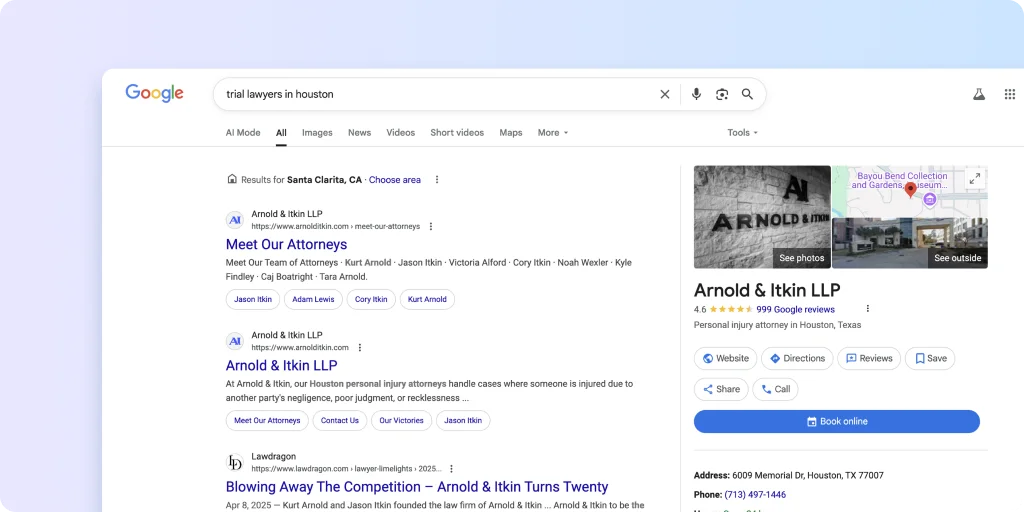
Google reviews are often the first credibility check. If you are not consistently earning reviews, you are not just losing reputation. You are losing potential clients. Scorpion’s 2025 Legal Consumer Insights Report shows that 62% of people check up to five different review sites, and 53% won’t consider firms rated below four stars.
Reputation matters and influences whether someone calls you or keeps scrolling. Tools like Reputation AI help firms generate reviews more consistently by prompting requests at the right time, responding quickly with customized replies, and giving visibility into client feedback across platforms.
The key? Make it a habit.
Build review requests into the close of a case.
Every matter that ends well should trigger a simple, quick request while the positive experience is still fresh. Keep it human, make it easy, and do it consistently.
Step Five: Prioritize Response Time and Seamless Intake
Too many personal injury firms miss out on solid cases due to breakdowns in the intake process.
Delays in responding, inconsistent follow-up, limited access to attorneys, or rushed first conversations can undo the trust your marketing worked to build. Scorpion’s research shows 72% of potential clients will move on if they do not hear back within 24 hours, and over one-third expect a same-day callback. Decisions happen fast. 42% decide in less than four days, meaning the window for decision-making is usually hours, not days.
This is where small improvements can make a big impact:
- Better training
- Clearer call handling
- Automation that actually helps (not frustrates)
- Tools from Scorpion, like LeadsAI and IntakeAI, can help you see where leads drop off and how to fix it.
If you spend on ads but ignore intake, you are paying to create missed opportunities.
Step Six: Bringing it All Together
Once your foundation is solid, meaning your goals are defined, your brand is clear, your website builds trust, and your intake can keep up, it is time to scale with confidence.
At this stage, marketing should function as one connected system. The firms that grow consistently focus on a few core outcomes:
- Show up everywhere prospective clients are searching. Content that supports traditional Google results and emerging AI-driven search experiences, including strong case pages and clear answers to real questions.
- Stand out once your firm appears. Clear messaging, authentic video, and real stories that help people understand what it is like to work with your firm before they contact you.
- Responsiveness closes the gap. Around-the-clock availability with tools like AI chat and AI voice assistants captures inquiries after hours, supports intake during high volume, and prevents missed opportunities.
- Know what is working. Full-funnel tracking and reporting connect marketing activity to signed cases, allowing you to invest in what works and stop spending on what does not.
- Work with one integrated partner. This is where having one partner matters. When your website, advertising, content, intake tools, and reporting are managed together, marketing becomes easier to manage and more effective. Scorpion integrates with leading case management systems and is Clio’s only preferred marketing services partner.
Bringing it all together creates fewer gaps, clearer decisions, and a system built to support long-term growth.
Step Seven: Focus on Your Clients and Their Cases and Leave the Marketing to Us
At Scorpion, we understand that running a firm takes time, and marketing often gets pushed aside. Even when someone on your team handles marketing, they rarely have the bandwidth to master every part of digital strategy, keep up with changes, manage technology, produce videos, and oversee advertising all at once. This work requires a dedicated team and the right technology.
Our team of personal injury marketing experts specializes in helping firms grow more efficiently and profitably by pairing a customized strategy with the right tools and support.
Let’s talk about what comes next for your firm. Contact us today.