
What We Learned at Legalweek 2026: The Firms That Prove Results Will Secure More Cases
Every year, thousands of legal professionals descend on New York City for Legalweek, the industry’s largest gathering of attorneys, IT professionals, and legal operations leaders. This year, one theme echoed across nearly every panel, hallway conversation, and keynote: the pilot phase for AI is over, and the firms that can prove quantifiable results are pulling ahead.
For law firm owners, these shifts are already playing out in how prospective clients find, evaluate, and choose attorneys. Here’s what stood out and what it means for your firm.
The ROI Conversation Has Changed
A year ago, legal teams were still debating whether AI was worth the investment. That conversation is over.
At Legalweek 2026, the question wasn’t “should we adopt AI?” The real question was “how do we prove AI is delivering value?”
Panelists across multiple sessions described a shift from measuring time saved to measuring business outcomes: increased case throughput, faster speed to sign, and the ability to handle a higher volume of cases without adding staff. One speaker described a small legal team that used AI chat technology to respond to a critical opportunity within two minutes. That speed directly influenced the outcome.

The data backs this up. Scorpion’s Legal Consumer Insights Report, a survey of 3,000 legal consumers, found that 72% will move on if they don’t hear back within 24 hours, and 42% make their decision in less than four days. For firms of any size, faster and more consistent responses translate directly to more retained cases.
That same consumer research found that 51% of people never make it past the fifth search result, 75% contact no more than five firms, and 53% won’t consider a firm rated below four stars. Whether it's someone searching for a criminal defense attorney after their loved one was just arrested at 2 am, or a parent served with custody papers at dinner searching for a family lawyer before the kids are in bed, the firm that is found first, looks reputable and responds that night secures the case.
Adoption of New Technology Is the Real Bottleneck
The most surprising theme at Legalweek wasn’t about the technology itself, but the people using it. Session after session confirmed that the biggest barrier to results isn’t selecting the right tool, it’s getting attorneys and staff to actually use it.
Speakers described a rational resistance to the change, as lawyers measured on billable output see learning a new system as a time tax. Successful firms overcame this by making results visible fast. One firm ran a week-long training boot camp, and within 30 days, the same attorneys who resisted were asking for more. Another firm assigned internal champions who learned tools deeply and helped colleagues one-on-one.
This matters for marketing technology too. The firms that see the strongest return on their marketing investment aren’t the ones with the most features. They’re the ones where every team member, from the receptionist to the managing partner, actually uses the tools that capture, route, and follow up with every lead.
Small Firms Have an Advantage (If They Move)
One of the most encouraging takeaways for smaller practices is agility is an asset.
Multiple panelists noted that smaller firms adopt new technology faster than large firms burdened by layers of approval, compliance review, and legacy systems. One personal injury firm grew from three to five attorneys by leaning into AI-powered workflows and investing in structured internal training.
You don’t need a 50-person IT department to compete. You need the right marketing partner that handles your strategy, manages your intake, and gives you visibility into which efforts are actually signing cases, all without requiring months of setup or a dedicated ops team.
What This Means for Your Firm
The firms pulling ahead in 2026 share three traits:
- They measure outcomes instead of activity
- They invest in technology adoption instead of just features
- They choose partners who align technology with business results
That’s the approach behind Scorpion’s RevenueMAX. Every piece of the platform is designed around the full journey from first search to signed case. Your firm shows up everywhere prospective clients are looking, with the right message at the right time. When they reach out, AI-powered intake and chat tools respond instantly, so no lead sits unanswered giving a competitor the chance to follow up first.
Beyond responsiveness, RevenueMAX gives your firm visibility into what’s actually working. Which campaigns are driving consultations? Which marketing channels are producing retained cases, not just clicks? That’s the kind of insight into ROI that Legalweek panelists kept coming back to. And because everything is integrated into one platform, your team doesn’t need to stitch together five different tools or hire a dedicated ops person to make sense of the data.
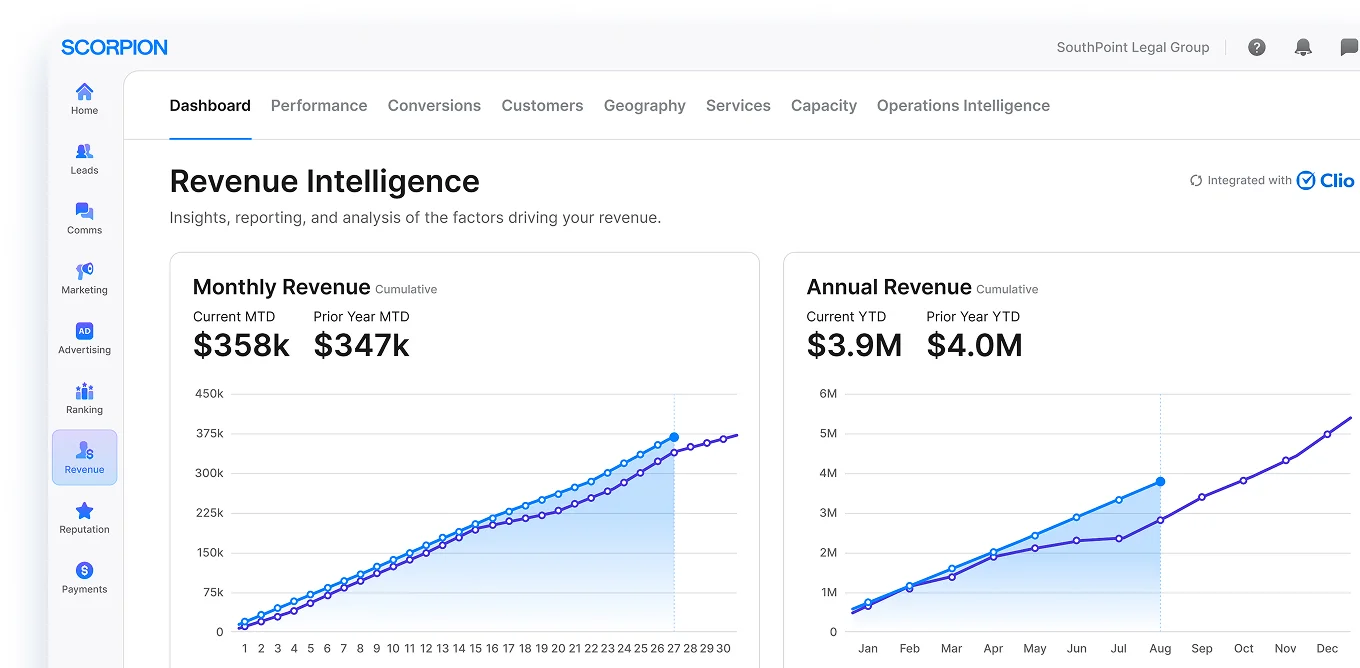
The firms investing in proving results are pulling ahead. If Legalweek 2026 signaled anything, it's that the gap between those firms and everyone else is widening fast.
The good news? You don’t have to figure it out alone.
Ready to see what sustainable growth looks like for your firm? Talk to Scorpion.